

Technical challenge
Painel do Lojista
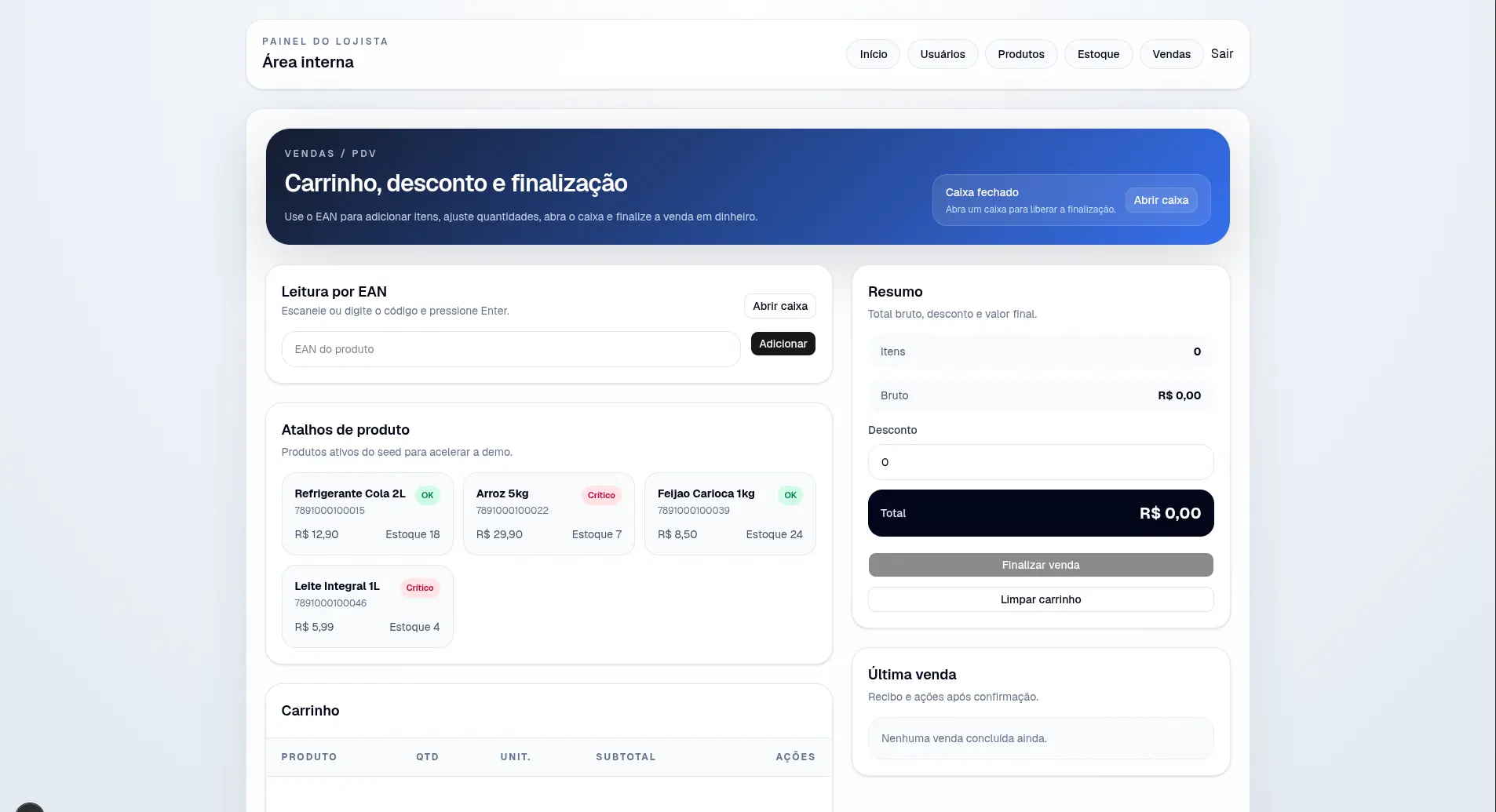
A full-stack MVP for store management, covering authentication, cash register operations, inventory control, and the sales workflow.
What it is
This project was built as the solution to a technical challenge focused on a realistic retail scenario. The goal was to deliver a functional system, not just isolated screens.
Repository: github.com/ericklucioh/Painel-do-Lojista
The problem it solves
The system centralizes common store operations in a single panel:
- sign-in and session control;
- role-based user management;
- product creation and maintenance;
- inventory movements;
- cash register opening;
- sales registration;
- sale summary and receipt generation.
Instead of treating each screen as a visual mock, the implementation connects frontend, backend, and database into one operational flow.
Architecture
2 apps
a Next.js frontend and an Express backend
Persistence
Prisma + MySQL
schema, migrations, and seed for reproducible local runs
Session
JWT + refresh
httpOnly cookies and role-protected routes
Delivery
Docker
complete local setup with compose, docs, and scripts
Technologies used
Frontend
- Next.js + React + TypeScript for the web application.
- App Router to separate authentication and dashboard flows.
- React Hook Form + Zod for predictable form validation.
- Tailwind CSS + shadcn/ui to speed up UI implementation.
Backend
- Node.js + Express + TypeScript for the API.
- Prisma for modeling, migrations, and database access.
- MySQL as the relational database for users, products, inventory, and sales.
- JWT + refresh token for authentication and session renewal.
Infra and quality
- Docker Compose to run frontend, backend, MySQL, and Adminer.
- ESLint, Prettier, and tests to keep the project consistent and validated.
- GitHub Actions for automated repository checks.
What I learned
This project mattered because it pushed me beyond basic CRUD work.
- Separation of concerns: frontend, backend, and business rules need clear boundaries if the system is going to scale.
- Real authentication: logging in is not enough; you have to think about cookies, refresh tokens, expiration, middleware, and role-based authorization.
- Flow modeling: inventory, cash register, and sales are connected. If the model is wrong, the whole application becomes inconsistent.
- Reproducible environments: documentation,
.env.example, seed data, and Docker make a huge difference for first-time setup. - Technical challenges are won in execution: not just by the stack you choose, but by turning scattered requirements into a coherent system.
Main takeaway
The biggest gain here was practicing end-to-end integration: interface, validation, authentication, persistence, and business rules working together in a production-like scenario.
What I would highlight in a portfolio
- a full-stack project with clear and useful scope;
- solid authentication and session handling;
- domain modeling that connects users, products, inventory, cash register, and sales;
- reproducible local setup for technical evaluation;
- enough documentation for someone else to run and understand the delivery.
Closing note
Painel do Lojista is a good example of the kind of project I like to build: less gimmick, more end-to-end systems with real attention to workflow, data, operations, and user experience.