

Personal product
ericklucioh.com
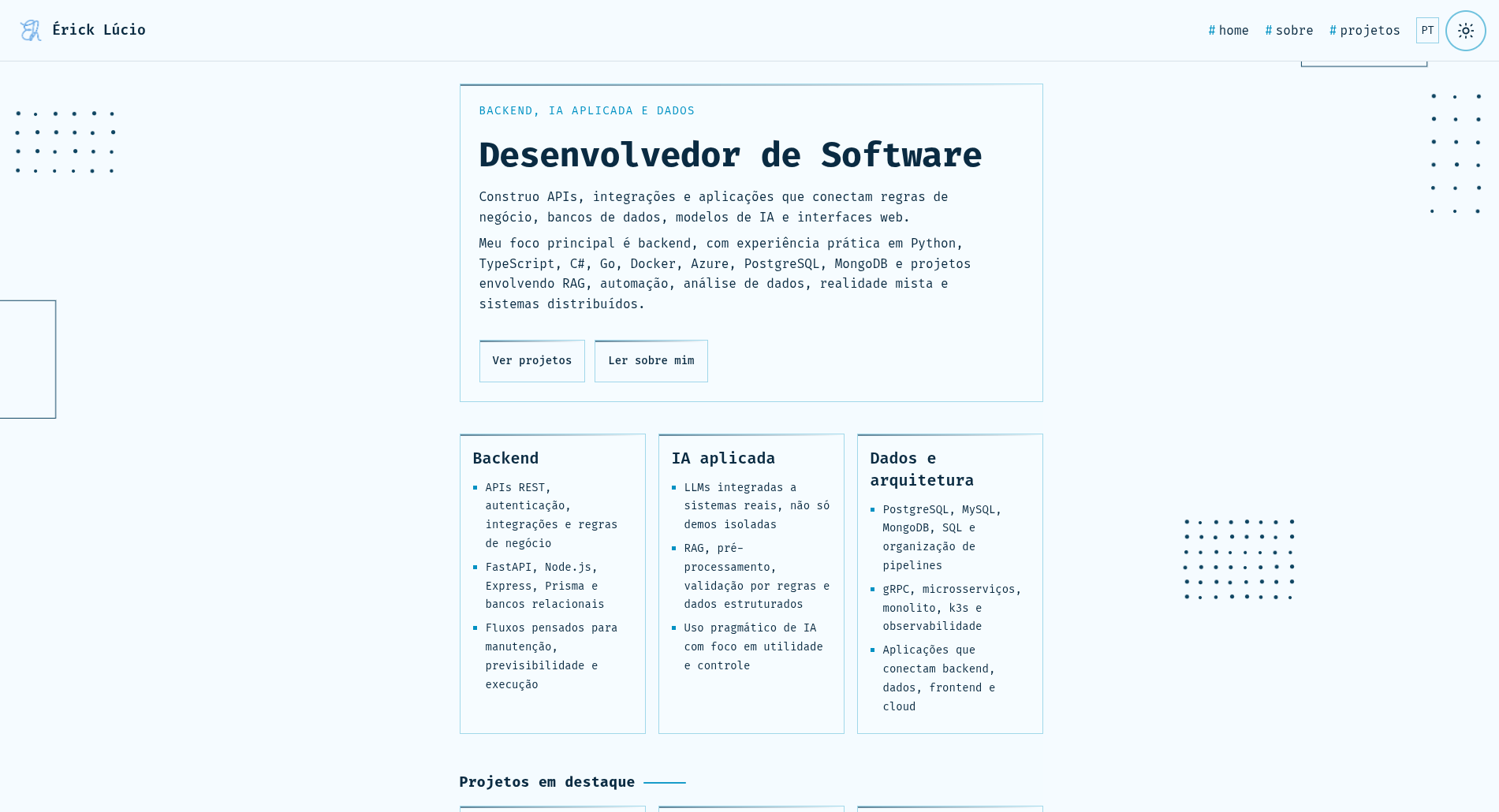
My personal site as a product-and-engineering project: a bilingual static portfolio built to present case studies, technical writing, and professional positioning in one coherent system.
What it is
This project is my own website. The goal was not just to have a landing page, but to build a public foundation that could organize professional narrative, case studies, technical content, and shareable assets in one cohesive system.
Website: ericklucioh.com
The problem it solves
Professional presence is often scattered across GitHub, LinkedIn, a PDF resume, and isolated repositories. This site was built to solve three problems at once:
- concentrate my professional presentation into one owned URL;
- turn projects into readable case studies instead of raw repository links;
- keep blog, resume, and institutional pages under the same visual system.
More than online presence, the goal here was to create an evaluation surface: someone should be able to visit the site and quickly understand my technical focus, preferred project types, execution style, and engineering depth.
Delivery
100% static
the build is exported without depending on a production Node runtime
Content
Bilingual MDX
posts and projects are edited as code in Portuguese and English
Positioning
Portfolio + blog
the same system supports professional narrative and technical writing
Distribution
Baseline SEO
metadata, Open Graph, sitemap, robots, and structured data
How the project is structured
The site was intentionally designed to avoid a CMS and keep content versioned next to the codebase.
App and navigation
- Next.js App Router to organize public routes and layouts;
- route-based i18n to separate Portuguese and English paths;
- static build output for predictable deployment on simple hosting.
Content
- MDX for projects and blog posts;
- frontmatter for title, date, excerpt, tags, stack, and optional image;
- reusable components for callouts, metrics, figures, and diagrams.
Visual identity
- monospace typography as a technical signature;
- custom color tokens with semantic light/dark layers;
- restrained layout with cards, thin borders, and subtle geometric decoration.
Core decision
I chose to treat content as part of the product, not as a separate layer. That makes maintenance more technical, but it also makes the portfolio more versionable, auditable, and consistent with the rest of the engineering.
What this project demonstrates
Even though it is a personal site, it acts as evidence of several skills:
- structured content modeling in code;
- metadata, Open Graph, and canonical route design;
- consistent UI across multiple pages and languages;
- concern for public publishing, static export, and ongoing maintainability.
It also demonstrates an important portfolio principle: clarity of communication is part of engineering. Strong systems lose value when they are presented poorly.
Assumed tradeoffs
Some choices were deliberate:
- content is manual and requires editorial discipline;
- the sitemap is still manually maintained in this version;
- the site prioritizes clarity and control over excessive motion or visual noise;
- the architecture is optimized for static publishing, not non-technical editing.
Why this is a strong case study
The value of this project is not a single feature. It is the combination of product thinking, frontend execution, structured content, technical SEO, and professional positioning in a simple sustainable base.
What I would highlight in a portfolio
- a personal site treated as a real product instead of a generic business card;
- bilingual content oriented around case studies;
- a simple static pipeline that is easy to publish and maintain;
- a custom visual identity with editorial and technical intent;
- a base prepared to grow with new projects, posts, and institutional pages.